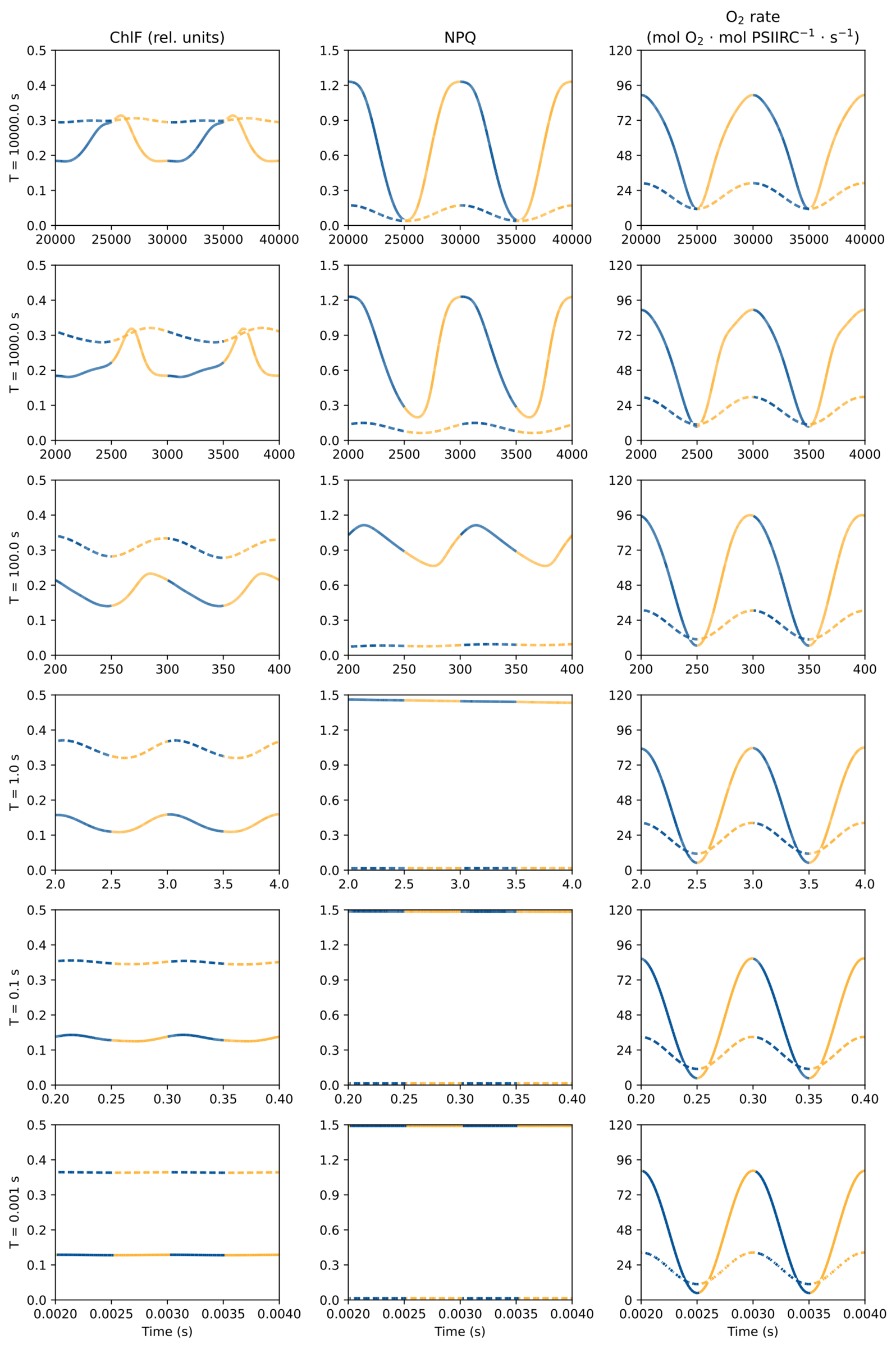
The Fuente 2024 model is a kinetic model of photosynthesis that is based on Occam's razor, aiming to provide the minimal complexity to describe the core processes of this model. In this case, the model focuses on the dynamic light oscillation and its responses on the photosynthetic machinery. It focuses only on the light-dependent reactions, including simplified versions of photosystem II, photosystem I, the Plastoquinone pool, and proton and ATP concentration in the lumen and stroma. On top of that, it shows the activation of non-photochemical quenching (NPQ), the dynamics of chlorophyll fluorescence, and the rate of oxygen evolution.
The model includes the oscillating light intensity as a sinusoidal function, where the amplitude and frequency are adjustable parameters. To allow for easier comparision to other models, that often see light intensity as a constant value, the oscillation is defined around a base light intensity. However, the strength of having light with a specific frequency lies in the additional information and therefore analysis possibilities that can be performed. In this case, the model is used to create Bode plots of the response of fluorescence to light oscillations and comparing these results to experimental data from Chlamydomonas reinhardtii.
This simple model stays true to its name and the authors aim to provide a base model that can be easily extended, while still showing a new approach to photosynthesis modelling. Their work shows that even with a simple model, new insights can be gained by using dynamic light protocols, which may have been overlooked in traditional steady-state models. To further extend the usability of the model, the authors provide a detailed notebook written in the Wolfram language, which also shows how to recreate some of the publication's figures.
Scheme
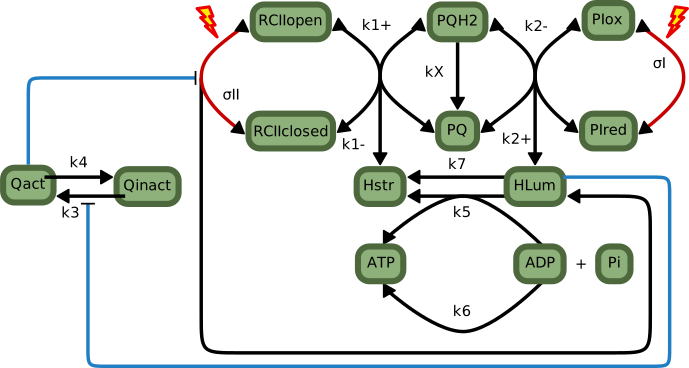
Model definition
Variables
| Symbol | ID | Initial value | Unit |
|---|---|---|---|
| Q_active | 1.6044277821745498e-23 | ||
| PQ | 3.537090541057567 | ||
| PSI_ox | 0.197310072778891 | ||
| H_lumen | 0.4120700665522831 | ||
| ATP_st | 144.95412072145785 |
Parameters
| Symbol | ID | Value | Unit |
|---|---|---|---|
| stoic_PSII | 1 | ||
| stoic_PSI | 1 | ||
| PQ_tot | 7 | ||
| H_stroma | 0.015848931924611134 | ||
| AP_tot | 1000 | ||
| V_lumen | 2.62e-21 | ||
| V_stroma | 2.09e-20 | ||
| sigma_PSI_0 | 1 | ||
| k1p | 25000 | ||
| k1m | 2500 | ||
| k2p | 100 | ||
| k2m | 10 | ||
| k3 | 0.05 | ||
| k4 | 0.004 | ||
| k5 | 100 | ||
| k6 | 10 | ||
| k7 | 500 | ||
| k_X | 1 | ||
| L_PSI | 10000 | ||
| bH | 0.01 | ||
| NPQ_max | 0.6 | ||
| cEqP | 4.3e-8 | ||
| keq_NPQ | 1 | ||
| n_NPQ | 5.3 | ||
| N_A | 602214076000000000 | ||
| PPFD | 50 | ||
| PPFD_add | 0 | ||
| f | 1 | ||
| PSI_total | 1 | ||
| Fluo_0 | 0.25 | ||
| Q_total | 1 |
Derived quantities
| Symbol | ID | Equation | Unit |
|---|---|---|---|
| Q_inactive | |||
| PQH_2 | |||
| PSI_red | |||
| ADP_st | |||
| osc_light | |||
| sigma_PSII | |||
| RCII_closed | |||
| RCII_open | |||
| Fluo | |||
| NPQ | |||
| O2 |
Reactions
| Symbol | ID | Rate | Stoichiometry | Unit |
|---|---|---|---|---|
| v_PSII_O2 | ||||
| v_PSI | ||||
| v_PSII_PQ | ||||
| v_PQH2_PSI | ||||
| v3 | ||||
| v4 | ||||
| v_ATPsynth | ||||
| v_ATPcons | ||||
| v_Leak | ||||
| v_PQ |
Curation
- July 2026: Maintenance by Marvin van Aalst
- June 2026: Initial implementation by Elouen Corvest
This model was validated by reproducing the following figures of the original publication. Due to copyright restrictions, a side-by-side comparison of the original figures is not shown here.
The authors provide the model as a Mathematica notebook. That notebook includes the model implementation, but not the simulation used for each figure. The reimplementation was based entirely on the notebook, yet errors remain in reproducing the figures. The errors mostly stem from simulations with light oscillations and very short periods. Because of these reproduction errors, some later figures could not be reproduced, also due to missing information on how. However, the steady-state figure is reproduced with very high accuracy; therefore, this model reimplementation is deemed semi-validated, with caution advised. Any support towards a better implementation is encouraged.
Figures
Fig2
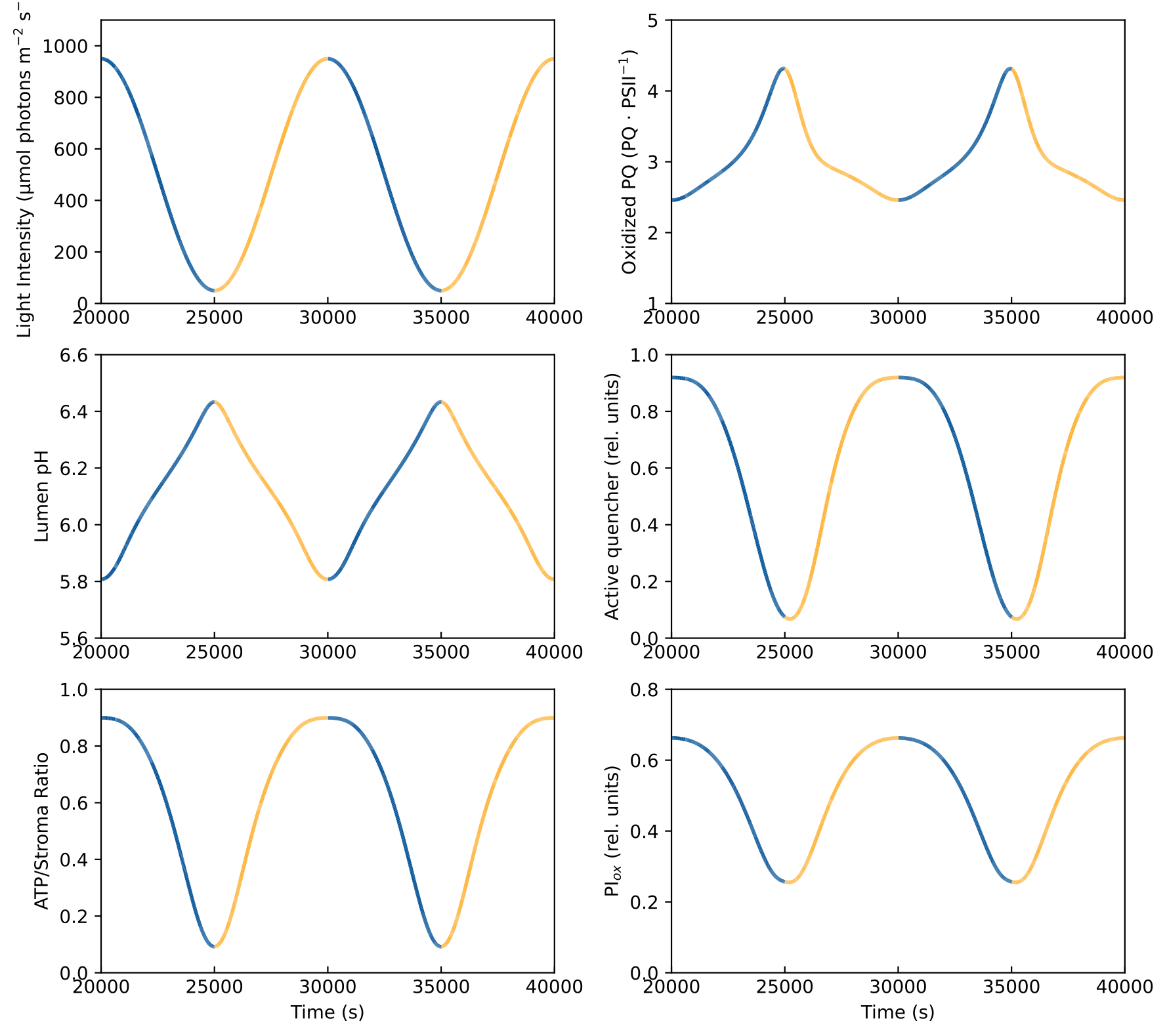
Fig3
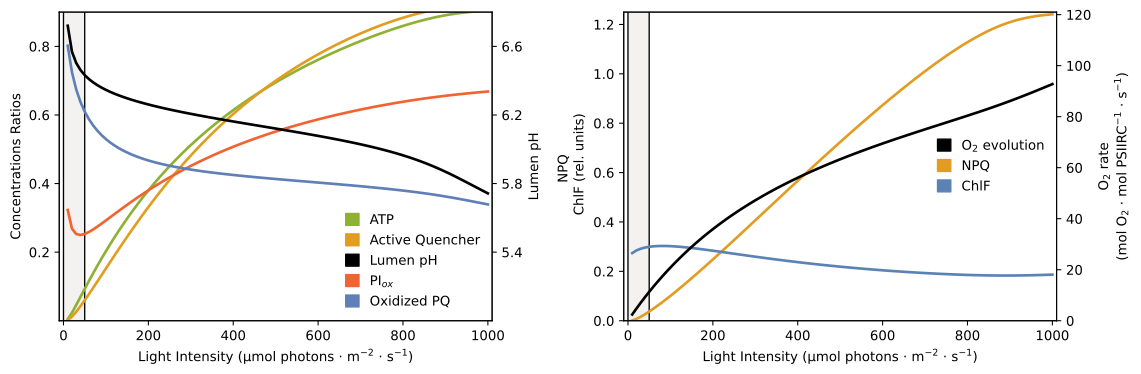
Fig4
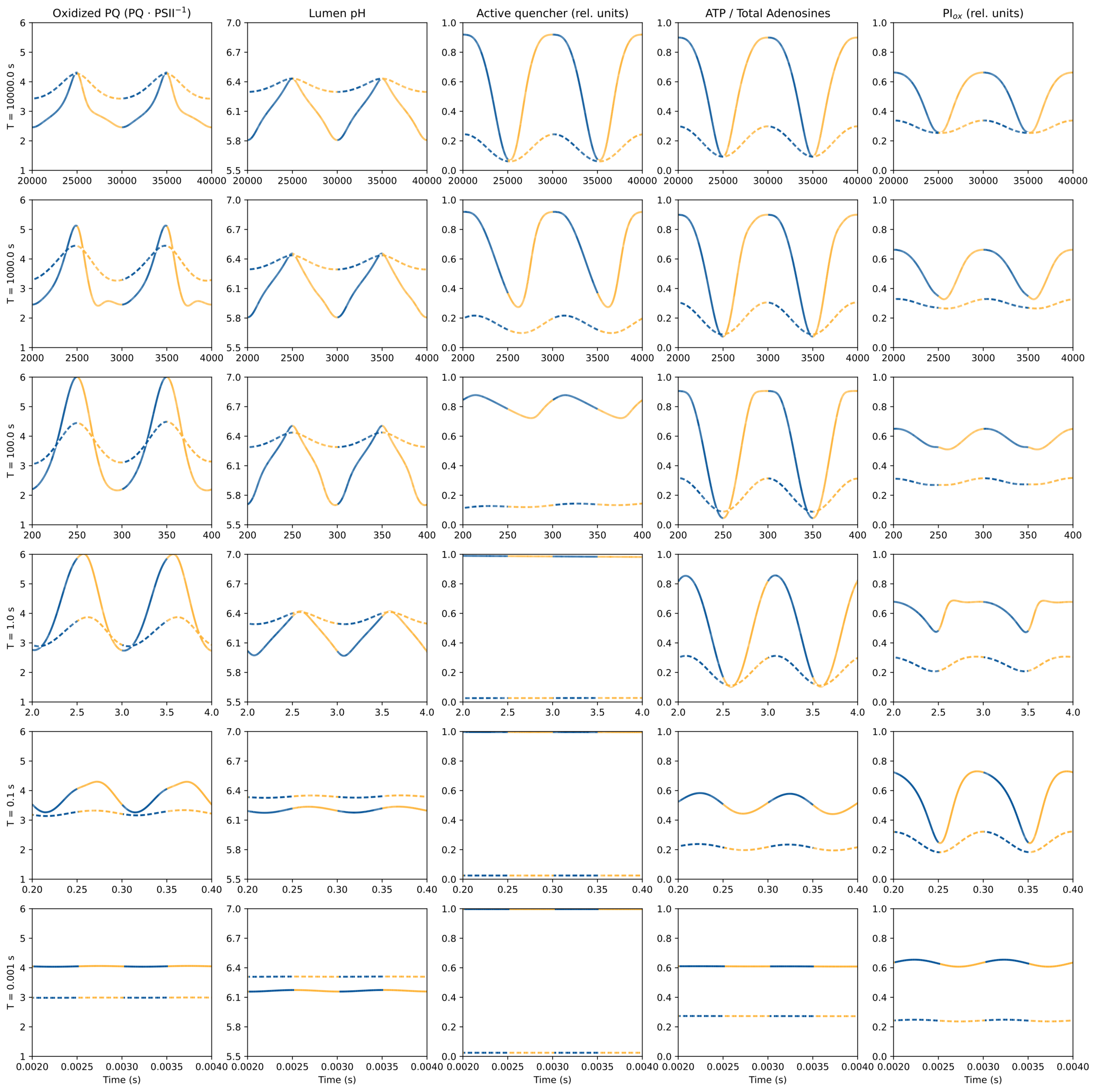
Fig5